
郭騰予 第十一週作業
Please use ChatGPT to explore a thematic series of questions within the scope of computational chemistry and follow up with further inquiries about any unfamiliar terms ( except homework )
Calculate the first 2 excited states of the Oxygen atom by using the CASSCF method with appropriate basis sets then compare with the experimental values.
6-311+G*
|
unit:eV |
3P-->1D | 1D-->1S |
| calculated values | 2.0 | 1.7 |
| experimental values | 1.97 | 2.22 |
| absolute errror | 0.03 | -0.52 |
aug-cc-pVTZ
| unit:eV | 3P-->1D | 1D-->1S |
| calculated values | 1.8 | 1.7 |
| experimental values | 1.97 | 2.22 |
| absolute errror | -0.17 | -0.52 |
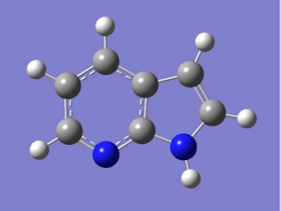
For 7-Azaindole there have normal form & tautomer form two different structures
- Which one is more stable at ground state
| (unit:kcal/mol) | normal form | tautomer form |
| Ground state | -238373.5 | -238360.5 |
- Will there is Transition State ( TS ) between the two structures? If so, what would be the barrier height between them?
Yes, there is transition state (TS) between the two structures.
| (unit: kcal/mol) | normal form | Transition state | tautomer form | ΔV‡ |
| Ground state | -238383.4 | -238317.9 | -238370.9 | 65.5 |
| Excited state | -238286.8 | -238239.3 | -238309.6 | 47.6 |
The barrier height
- Optimize the first excited state of two structures, and plot a simple energy level diagram based on the energy difference.
- Calculate the verticle excitation energy between the ground state & first excited state.
| Relative energy | |||
| (unit: kcal/mol) | normal form | Transition state | tautomer form |
| Ground state | 0.0 | 65.5 | 12.5 |
| Excited state | 96.5 | 144.1 | 73.8 |

Reference
Energy Levels of Neutral Oxygen ( O I ) (nist.gov)