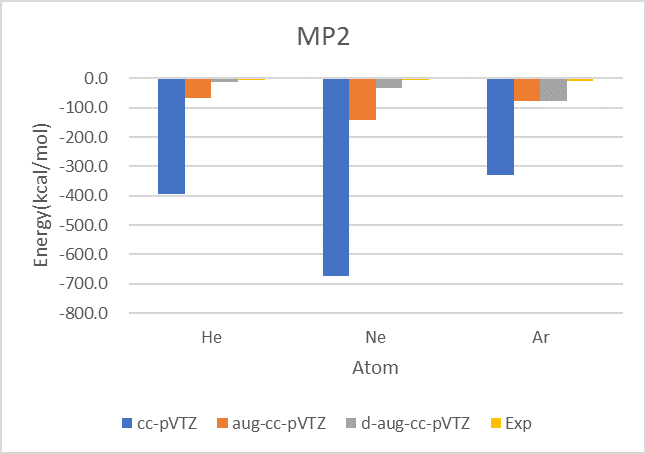
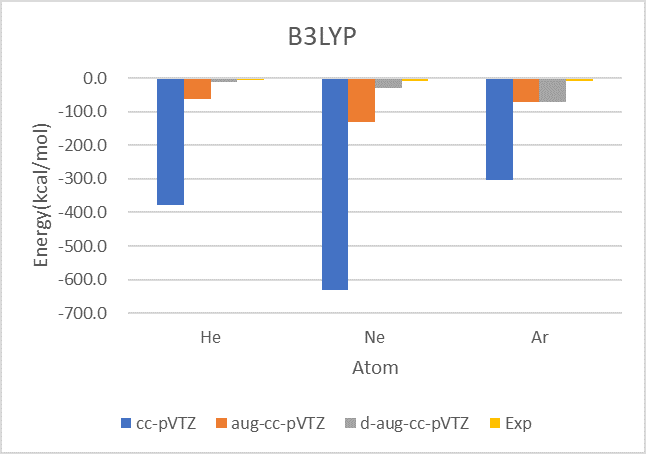
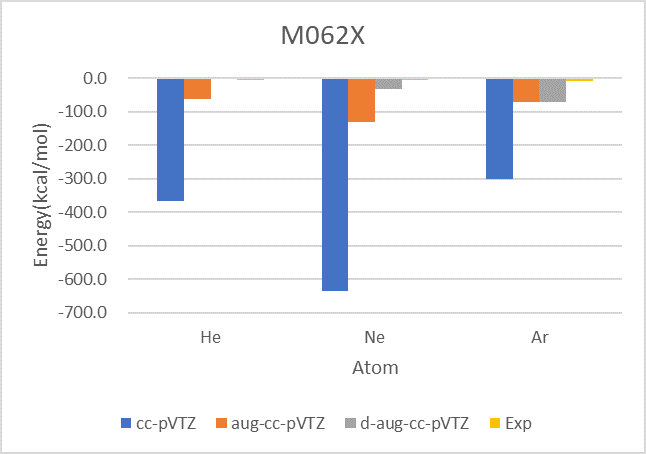
•Calculate the Electron Affinity of Helium、Neon、Argon, by using B3LYP、MP2 and M062X theoretical methods with cc-pVTZ、aug-cc-pVTZ、d-aug-cc-pVTZ basis set, and do some simple statistical analysis.
| EA | MP2 | EA | B3LYP | EA | M062X | |||||||||
| (unit:kcal/mol) | Exp | cc-pVTZ | aug-cc-pVTZ | d-aug-cc-pVTZ | (unit:kcal/mol) | Exp | cc-pVTZ | aug-cc-pVTZ | d-aug-cc-pVTZ | (unit:kcal/mol) | Exp | cc-pVTZ | aug-cc-pVTZ | d-aug-cc-pVTZ |
| He | -5 | -394.5 | -68.3 | -13.2 | He | -5 | -376.8 | -61.9 | -10.1 | He | -5 | -367.4 | -62.7 | -10.7 |
| Ne | -6.9 | -672.0 | -141.3 | -33.4 | Ne | -6.9 | -630.0 | -130.2 | -28.4 | Ne | -6.9 | -634.6 | -131.7 | -31.8 |
| Ar | -8.4 | -330.7 | -77.8 | -77.8 | Ar | -8.4 | -302.7 | -72.2 | -72.2 | Ar | -8.4 | -301.1 | -72.8 | -72.8 |
Reference : Atkins' PHYSICAL CHEMISTRY 10th Ed

•Try to add an additional set of diffuse functions for the s orbital of He, and the s and p orbitals of Ne and Ar. ( in the 6-31G basis set )




•Try to use Gaussian or WebMO to optimize the H₃⁺ molecule and calculate the linear dissociation energy according to the formula provided in the PDF lecture.
H3+ → 2H + H+
H3+ →H2 + H+
H3+ → H2+ + H
| #CISD/aug-cc-pVTZ | unit:kcal/mol | |||
| H3+ | H | H+ | H2 | H2+ |
| -801.4 | -313.6 | 0.0 | -735.8 | -378.0 |
| H3+ | 2H, H+ | H2, H+ | H2+, H |
| -801.4 | -627.3 | -735.8 | -691.6 |
| dissociation energy | 174.1 | 65.6 | 109.8 |