|
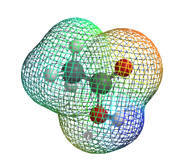
•Find the transition state and calculate the barrier height for CH3F + F− → CH3F + F− with following model. |
|
Model: |
|
Method: |

| Gas phase | EB.O.(kcal/mol) | Microsolvation | EB.O.(kcal/mol) | Continuum model | EB.O.(kcal/mol) |
| CH3F | -87485.6 | CH3F | -87485.6 | CH3F | -87487.8 |
| F- | -62541.3 | F-+H2O | -110422.6 | F- | -62624.8 |
| TS | -150029.1 | TS | -197899.5 | TS | -150092.7 |
| Barrier height | ΔEB.O.(kcal/mol) | ΔEB.O.(kcal/mol) | ΔEB.O.(kcal/mol) | ||
| -2.1 | 8.7 | 20.0 |
-->According to the results, as the number of water molecules increases, the barrier height becomes larger.
Gas:

Microsolvation: 反應物(右)-因為水是加在F-

Continuum Model: 把水分子看成是一種連續而沒有結構的介質

(Continuum model :溶質分子的電荷分布極化了溶劑分子,此極化作用產生了一個電場稱為 Reaction Field,此電場與溶質分子的電荷分布作用進一步降低了溶質分子的能量)
(溶劑效應是因為溶劑被極化,產生了一個電場稱為 Reaction Field,溶質電子結構會被電場影響)
log檔
----------------------------------------------------------------------------------------------------
