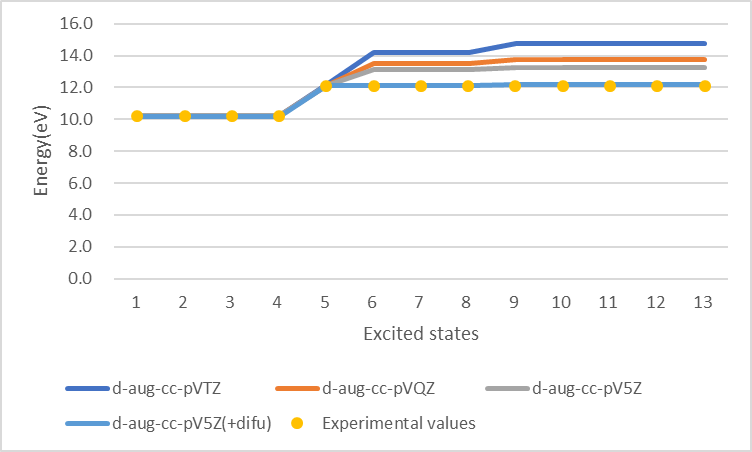
•Calculate the first 13 excited states of Hydrogen atom by using the CIS theoretical method with appropriate basis sets then compare with the experimental values.
Table1. Energies of the excited states of hydrogen atoms
| Unit:eV | 2S | 2P | 3S | 3P | 3D | MAE | ||||||||
| d-aug-cc-pVTZ | 10.2 | 10.2 | 10.2 | 10.2 | 12.2 | 14.2 | 14.2 | 14.2 | 14.7 | 14.7 | 14.7 | 14.7 | 14.7 | 1.51 |
| d-aug-cc-pVQZ | 10.2 | 10.2 | 10.2 | 10.2 | 12.1 | 13.5 | 13.5 | 13.5 | 13.8 | 13.8 | 13.8 | 13.8 | 13.8 | 0.97 |
| d-aug-cc-pV5Z | 10.2 | 10.2 | 10.2 | 10.2 | 12.1 | 13.1 | 13.1 | 13.1 | 13.3 | 13.3 | 13.3 | 13.3 | 13.3 | 0.68 |
| d-aug-cc-pV5Z(+difu) | 10.2 | 10.2 | 10.2 | 10.2 | 12.1 | 12.1 | 12.1 | 12.1 | 12.2 | 12.2 | 12.2 | 12.2 | 12.2 | 0.04 |
| Experimental values | 10.2 | 10.2 | 10.2 | 10.2 | 12.1 | 12.1 | 12.1 | 12.1 | 12.1 | 12.1 | 12.1 | 12.1 | 12.1 | |
Reference : J Mol Model . 2022 Aug 30;28(9):282.
•Calculate the first 5 excited states of Helium by using the CIS、CIS(D) theoretical method with appropriate basis sets then compare with the experimental values.
Table2. First 5 excited states of Helium energy
| CIS (unit:eV) | 1 | 2 | 3 | 4 | 5 |
| d-aug-cc-pVTZ | 21.1 | 22.1 | 22.1 | 22.1 | 24.2 |
| d-aug-cc-pVQZ | 21.1 | 21.9 | 21.9 | 21.9 | 24.0 |
| d-aug-cc-pV5Z | 21.1 | 21.8 | 21.8 | 21.8 | 23.9 |
| d-aug-cc-pV5Z(+difu) | 19.9 | 20.3 | 20.3 | 20.3 | 20.9 |
| Experimental values | 19.8 | 20.6 | |||
| CIS(D) (unit:eV) | 1 | 2 | 3 | 4 | 5 |
| d-aug-cc-pVTZ | 21.1 | 22.1 | 22.1 | 22.1 | 24.2 |
| d-aug-cc-pVQZ | 21.1 | 21.9 | 21.9 | 21.9 | 24.0 |
| d-aug-cc-pV5Z | 21.1 | 21.9 | 21.9 | 21.9 | 24.0 |
| d-aug-cc-pV5Z(+difu) | 19.8 | 20.2 | 20.2 | 20.2 | 20.8 |
| Experimental values | 19.8 | 20.6 | |||
Reference : J Mol Model . 2022 Aug 30;28(9):282.
| MAE(unit:eV) | CIS | CIS(D) |
| d-aug-cc-pVTZ | 2.4 | 2.3 |
| d-aug-cc-pVQZ | 2.2 | 2.2 |
| d-aug-cc-pV5Z | 2.1 | 2.2 |
| d-aug-cc-pV5Z(+difu) | 0.4 | 0.3 |