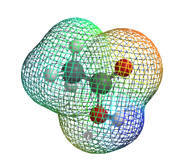
1.Find the transition state and calculate the barrier height (ΔV≠) for the following reaction.
reaction:HNC → HCN
methods : MP2/aug-cc-pVTZ、MP2/6-31+G**
Transiton state strcture
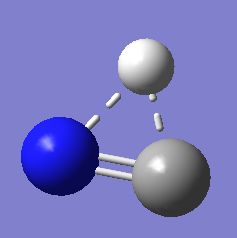
Bind length:C-N:1.1967 N-H:1.4 C-H:1.2 Bond Angle:52
(ΔV≠)=Energy of (TS-HNC)hatree*627.503 (kcal/mol)
1.Table the Energy of Born oppenheimer Energy (Hartree)
| MP2/6-31+G** | E(Hartree) | kcal/molΔV≠ |
| CNH | -93.14306 | |
| HCN | -93.17212 | 35.17091565 |
| TS | -93.08701 |
| MP2/aug-cc-pVTZ | E(Hartree) | kcal/molΔV≠ |
| CNH | -93.23130 | |
| HCN | -93.25982 | 34.40034196 |
| TS | -93.17648 |
Results show aug-cc-pVTZ have lower barrier height than 6-31+G** about 0.8(kcal/mol)
aug-cc-pVTZ is triple-zta basis set,so the energy will be more accurate.
2.Calculate the k(rate constant) in different temperatures (at least 3 different temperatures) for the following reaction and plot of ln(k) versus 1000/T then compare with the experimental values.
methods : MP2/aug-cc-pVTZ、MP2/6-31+G**
Hint: The plot should be an Arrhenius plot

1.reaction:CH4 +OH․→ H2O + CH3․
| Unit:Hartree | 298K | 398K | 600K |
| TS | -115.86330 | -115.87424 | -115.89840 |
| OH | -75.54925 | -75.55620 | -75.57104 |
| CH4 | -40.33706 | -40.34434 | -40.36017 |
| ΔG(Kcal/mol) | 10.24 | 12.30 | 16.39 |
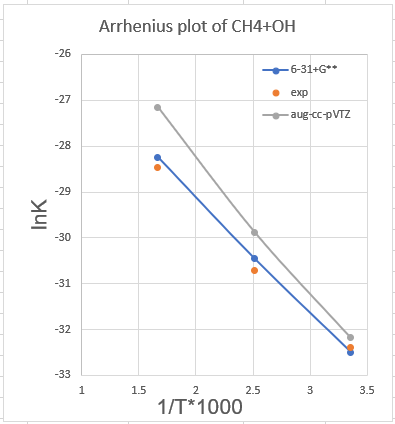
| Arrhenius plot | 6-31+G** | aug-cc-pVTZ | exp |
| 298K | -32.49 | -32.18 | -32.40 |
| 398K | -30.45 | -29.87 | -30.70 |
| 600K | -28.24 | -27.15 | -28.45 |
2.reaction:CD4 +OH․→ H2O(1 H will replace by D) + CD3․
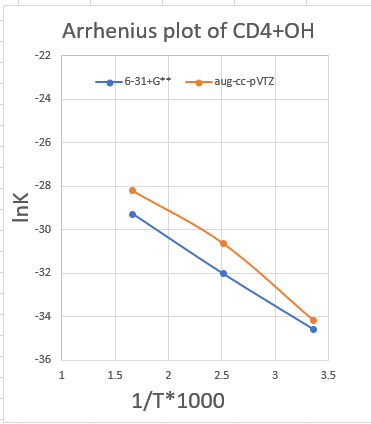
| Arrhenius plot | 6-31+G** | aug-cc-pVTZ |
| 298K | -34.57 | -34.17 |
| 398K | -32.03 | -30.63 |
| 600K | -29.29 | -28.20 |
KIE=KH/KD
| KIE | 298K | 398K | 600K |
| 6-31+G** | 8.02 | 4.85 | 2.86 |
| aug-cc-pVTZ | 7.34 | 5.35 | 2.85 |
Please use ChatGPT to explore a thematic series of questions within the scope of computational chemistry and follow up with further inquiries about any unfamiliar terms ( except homework )