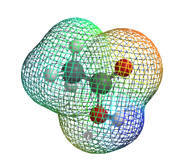
•Use Gaussian or WebMO to calculate the Electron Affinity of Helium、Neon、Argon, by using B3LYP、MP2 and M062X theoretical methods with cc-pVTZ、aug-cc-pVTZ、d-aug-cc-pVTZ basis set, and do some simple statistical analysis.
| EA | (unit:kcal/mol) | |||
| He | Ne | Ar | ||
| MP2 | cc-pVTZ | -394.5 | -672.0 | -330.7 |
| aug-cc-pVTZ | -68.3 | -141.3 | -77.8 | |
| d-aug-cc-pVTZ | -13.2 | -33.4 | -77.8 | |
| B3LYP | cc-pVTZ | -376.8 | -630.0 | -302.7 |
| aug-cc-pVTZ | -61.9 | -130.2 | -72.2 | |
| d-aug-cc-pVTZ | -10.1 | -28.4 | -72.2 | |
| M062X | cc-pVTZ | -367.4 | -634.6 | -301.1 |
| aug-cc-pVTZ | -62.7 | -131.7 | -72.8 | |
| d-aug-cc-pVTZ | - | -31.8 | -72.8 | |
| 實驗值a | -5.0 | -6.9 | -8.4 |
a: Atkins' PHYSICAL CHEMISTRY
|
Absolute Error |
|
He |
Ne |
Ar |
MAE |
RMSE |
|
MP2 |
cc-pVTZ |
389.5 |
665.1 |
322.3 |
459.0 |
476.6 |
|
|
aug-cc-pVTZ |
63.3 |
134.4 |
69.4 |
89.1 |
93.3 |
|
|
d-aug-cc-pVTZ |
8.2 |
26.5 |
69.4 |
34.7 |
41.2 |
|
B3LYP |
cc-pVTZ |
371.8 |
623.1 |
294.3 |
429.7 |
446.6 |
|
|
aug-cc-pVTZ |
56.9 |
123.3 |
63.8 |
81.3 |
85.3 |
|
|
d-aug-cc-pVTZ |
5.1 |
21.5 |
63.8 |
30.1 |
37.0 |
|
M062X |
cc-pVTZ |
362.4 |
627.7 |
292.7 |
427.6 |
445.5 |
|
|
aug-cc-pVTZ |
57.7 |
124.8 |
64.4 |
82.3 |
86.3 |
|
|
d-aug-cc-pVTZ |
- |
24.9 |
64.4 |
44.7 |
47.5 |
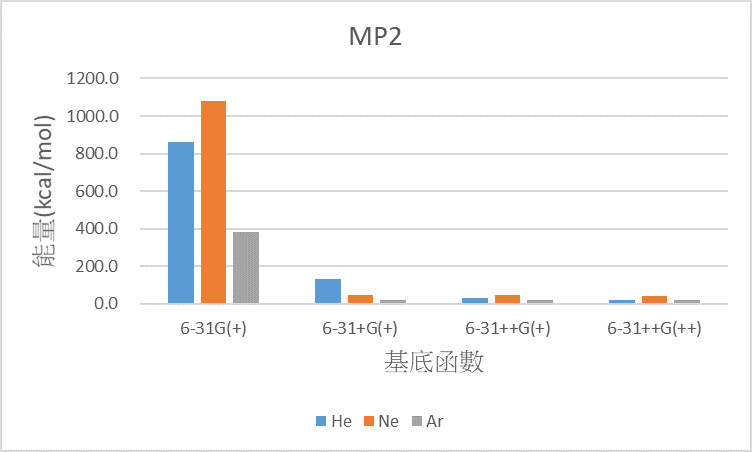
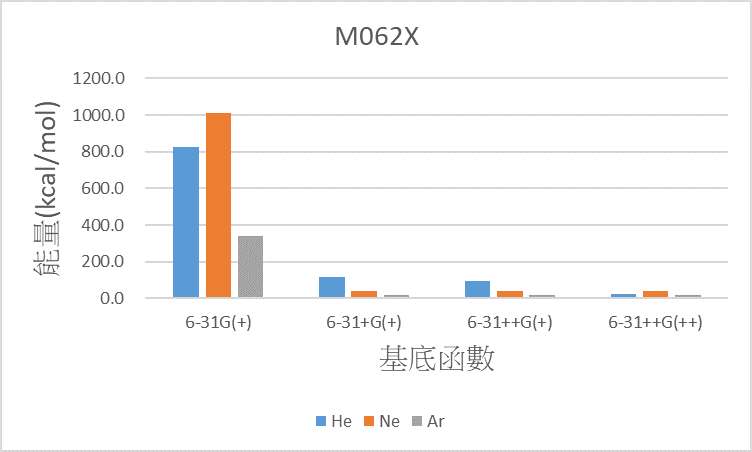
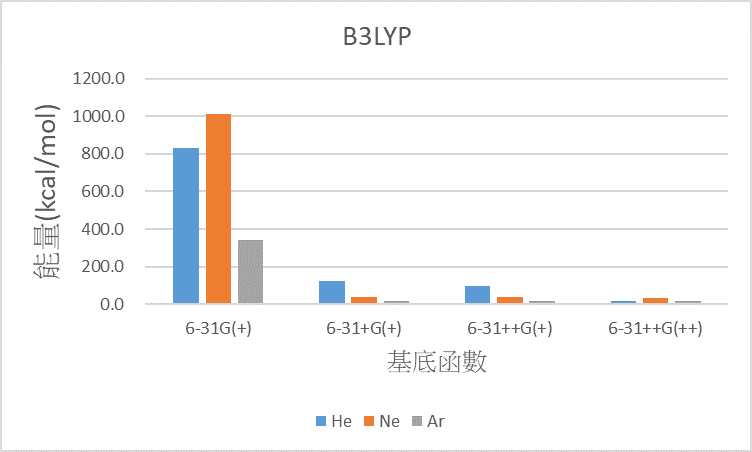
•Try to add an additional set of diffuse functions for the s orbital of He, and the s and p orbitals of Ne and Ar. ( in the 6-31G basis set )
| EA | (kcal/mol) | He | Ne | Ar |
| MP2 | 6-31G(+) | 860.3 | 1080.9 | 382.1 |
| 6-31+G(+) | 133.6 | 44.7 | 20.0 | |
| 6-31++G(+) | 30.9 | 44.7 | 20.0 | |
| 6-31++G(++) | 23.0 | 42.0 | 20.0 | |
| B3LYP | 6-31G(+) | 829.9 | 1009.4 | 343.5 |
| 6-31+G(+) | 122.4 | 37.0 | 14.5 | |
| 6-31++G(+) | 95.3 | 37.0 | 14.5 | |
| 6-31++G(++) | 18.9 | 34.6 | 14.5 | |
| M062X | 6-31G(+) | 827.9 | 1011.2 | 341.3 |
| 6-31+G(+) | 119.2 | 41.7 | 17.2 | |
| 6-31++G(+) | 94.8 | 41.7 | 17.2 | |
| 6-31++G(++) | 21.9 | 39.3 |
17.2
|
| 絕對誤差 | He | Ne | Ar | MAE | |
| MP2 | 6-31G(+) | -865.3 | -1087.8 | -390.5 | 781.2 |
| 6-31+G(+) | -138.6 | -51.6 | -28.4 | 72.8 | |
| 6-31++G(+) | -35.9 | -51.6 | -28.4 | 38.6 | |
| 6-31++G(++) | -28.0 | -48.9 | -28.4 | 35.1 | |
| B3LYP | 6-31G(+) | -834.9 | -1016.3 | -351.9 | 734.4 |
| 6-31+G(+) | -127.4 | -43.9 | -22.9 | 64.7 | |
| 6-31++G(+) | -100.3 | -43.9 | -22.9 | 55.7 | |
| 6-31++G(++) | -23.9 | -41.5 | -22.9 | 29.4 | |
| M062X | 6-31G(+) | -832.9 | -1018.1 | -349.7 | 733.6 |
| 6-31+G(+) | -124.2 | -48.6 | -25.6 | 66.1 | |
| 6-31++G(+) | -99.8 | -48.6 | -25.6 | 58.0 | |
| 6-31++G(++) | -26.9 | -46.2 | -25.6 | 32.9 |
•Try to use Gaussian or WebMO to optimize the H₃⁺ molecule and calculate the linear dissociation energy according to the formula provided in the PDF lecture.
H3+ → 2H + H+
H3+ →H2 + H+
H3+ →H2+ + H
| (kca/mol) | |||||
| #CISD/aug-cc-pVTZ | H3+ | H | H+ | H2 | H2+ |
| -801.3903744 | -313.6425513 | 0 | -735.84 | -377.95 |
| H3+ | 2H + H+ | H2 + H+ | H2+ + H |
| -801.3903744 | -627.2851026 | -735.839979 | -691.5925899 |
| dissociation energy | 174.1052718 | 65.55039538 | 109.7977845 |
Reference: Atkins' PHYSICAL CHEMISTRY